- Property value is one of the strongest drivers of lease extension premiums across 443 tribunal decisions.
- Median premiums rise from £13,216 for properties under £250,000 to £572,500 for properties over £1 million.
- Above £600,000, the gap between median and mean widens sharply, driven by exceptional central London cases.
- Marriage value on short leases combined with high property values produces the largest determinations in the dataset.

Higher property values generally attract higher premiums, but the spread widens as values rise because valuation assumptions, ground rent structures and comparable evidence also influence the outcome.
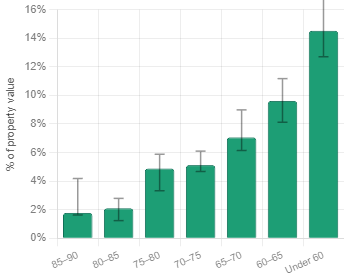
Expressing the premium as a share of property value provides a more meaningful cross-band comparison than absolute figures alone.
Why property value drives lease extension cost
Lease extension premiums are calculated using a valuation formula that takes the property's freehold value as a starting point. Higher-value properties generate larger reversionary values for freeholders, which directly increases the premium required to compensate them. This relationship is broadly linear up to around £600,000, beyond which the impact of very short leases and marriage value can produce extremely large premiums.
The tribunal data confirms this clearly. Across 443 decisions where both a tribunal-determined premium and a property value were recorded, median premiums rise consistently with property value — from £13,216 for properties worth under £250,000 to £572,500 for properties worth over £1 million.
| Property value band | Decisions analysed | Median premium | Mean premium |
|---|---|---|---|
| Under £250,000 | 186 | £13,216 | £17,320 |
| £250,000–£399,999 | 165 | £27,160 | £33,189 |
| £400,000–£599,999 | 61 | £38,172 | £40,547 |
| £600,000–£799,999 | 16 | £50,268 | £121,782 |
| £1,000,000+ | 11 | £572,500 | £562,579 |
The £600k+ premium effect
Properties above £600,000 show a striking divergence between median (£50,268) and mean (£121,782) premiums. This reflects a small number of very high-value cases involving very short unexpired terms combined with high property values — a combination that triggers both full marriage value and a large reversion calculation.
The £1 million+ band, while only 11 decisions, has a median of £572,500. Every case in this band involved a property in central London, and many had fewer than 20 years of lease remaining. These are not typical lease extension scenarios — they represent the most extreme end of the market.
What drives the premium within each band
Within any property value band, the single most important secondary factor is years remaining on the lease. A flat worth £350,000 with 85 years remaining will attract a substantially lower premium than an identical flat with 65 years remaining. The 80-year threshold is particularly significant: once a lease falls below 80 years, marriage value becomes payable, often adding 30–50% or more to the premium.
Ground rent level is a further variable. High ground rents increase the deferment value component of the calculation, adding to the overall premium. Tribunal decisions in the dataset show that ground rent type (fixed, reviewable, or RPI-linked) affects outcomes across all property value bands.
Received a lease extension quote?
Compare it against comparable First-tier Tribunal decisions.
Check My QuoteFrequently asked questions
Methodology
LeaseIntel analyses published First-tier Tribunal (Property Chamber) decisions on lease extension premiums. Each decision is parsed into a structured record covering unexpired term at the valuation date, property value, ground rent profile, deferment and capitalisation rates, marriage value treatment and the final premium determined.
- Analyses only include decisions containing the specific lease-term and valuation data required for that study.
- Cases are grouped by unexpired term at the valuation date (not the date of the decision).
- Sample sizes vary between analyses because not every decision records every variable.
- Small sample groups are flagged with a confidence indicator and interpreted cautiously.
- Where decisions span multiple flats or hearings, each lease is treated as a separate observation.
Read the full LeaseIntel methodology for dataset construction, variable definitions and validation checks.
Limitations & Caveats
- Tribunal decisions represent disputed cases rather than the entire market.
- Not all decisions contain every data field.
- Sample sizes vary by analysis.
- Small sample groups should be interpreted cautiously.
Benchmark your quote
These figures are based on 443 tribunal decisions covering a range of property values. Your own premium depends on your property's specific value, the years remaining on your lease, ground rent terms and the valuation evidence presented. LeaseIntel compares your circumstances with similar tribunal decisions to provide a personalised benchmark.
Is My Lease Extension Quote Too High?Independent · Not a valuation or legal advice · Tribunal outcomes, not formula estimates