- Lease length is the single strongest predictor of premium across 595 tribunal decisions.
- The median premium nearly doubles between the 80–89 year band (£7,046) and the 70–79 year band (£12,622) — the 80-year marriage-value threshold.
- Between 70–79 and 60–69 years the median almost doubles again; from 60–69 to 50–59 years it nearly doubles once more.
- Under 40 years, the median jumps to £236,988 with individual cases exceeding £2.9 million.
- Sample sizes are largest in the 50–69 year bands, giving highest confidence in those figures.
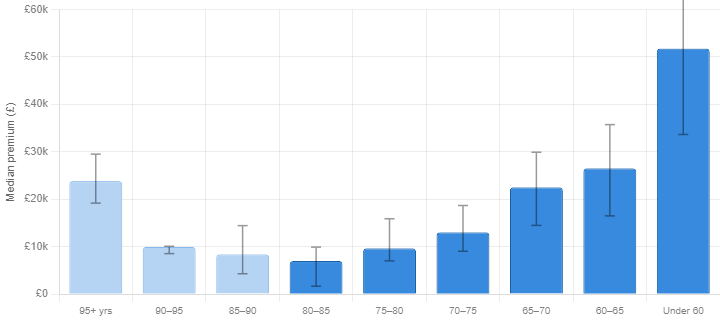
Premiums are broadly stable above 80 years and accelerate as the unexpired term falls, with a discrete uplift at the 80-year marriage-value threshold.
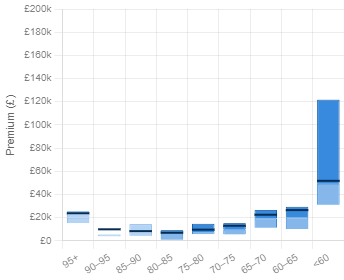
Two leases with similar unexpired terms can produce very different determinations once ground rent, deferment rate and relativity are disputed. Variance widens below 80 years.

Confidence is highest in bands with the largest number of decisions; bands with smaller samples should be interpreted more cautiously.
How premiums change with lease length
The relationship between lease length and premium is not linear — it accelerates sharply at two key thresholds: 80 years and approximately 60 years. Above 80 years, premiums are comparatively modest because marriage value does not apply and the reversion is far in the future. Below 80 years, marriage value becomes payable and costs begin to rise steeply. Below 60 years, the rate of increase accelerates further as the reversion value grows and the lease becomes increasingly problematic for mortgage lenders.
Across 595 tribunal decisions with both term and premium data, the median premium almost doubles between the 70–79 year band (£12,622) and the 60–69 year band (£23,463), and nearly doubles again between 60–69 years and 50–59 years (£41,384).
| Years remaining | Decisions analysed | Median premium | Mean premium | Largest premium |
|---|---|---|---|---|
| Under 40 years | 63 | £236,988 | £468,962 | £2,931,089 |
| 40–49 years | 41 | £47,300 | £77,545 | £366,870 |
| 50–59 years | 136 | £41,384 | £59,747 | £548,300 |
| 60–69 years | 213 | £23,463 | £28,793 | £235,000 |
| 70–79 years | 103 | £12,622 | £14,201 | £38,517 |
| 80–89 years | 30 | £7,046 | £7,813 | £30,580 |
The 80-year threshold in the data
The jump between the 80–89 year band (median £7,046) and the 70–79 year band (median £12,622) represents a near-doubling of the typical premium — and this is the crossing of the 80-year threshold where marriage value first becomes payable under current legislation.
This is the clearest finding in the entire LeaseIntel dataset: once a lease falls below 80 years, the median premium increases by approximately 79% compared with leases just above that threshold. For a property worth £400,000, the difference between extending at 81 years versus 79 years remaining can represent a premium increase of £15,000–£25,000 or more.
Very short leases: the extreme end
The under-40 year band shows a median premium of £236,988 — nearly ten times the 70–79 year median. These cases typically involve properties in prime central London with extremely short unexpired terms, where the combination of high property values, substantial marriage value, and a near-term reversion produces very large premiums.
The mean premium for under-40-year leases is £468,962 — nearly double the median — reflecting a small number of exceptional central London cases above £1 million. Properties with fewer than 40 years remaining also face significant mortgage difficulties, making extension not optional but essential for sale or remortgage. This urgency is reflected in the tribunal outcomes.
Received a lease extension quote?
Compare it against comparable First-tier Tribunal decisions.
Check My QuoteFrequently asked questions
Methodology
LeaseIntel analyses published First-tier Tribunal (Property Chamber) decisions on lease extension premiums. Each decision is parsed into a structured record covering unexpired term at the valuation date, property value, ground rent profile, deferment and capitalisation rates, marriage value treatment and the final premium determined.
- Analyses only include decisions containing the specific lease-term and valuation data required for that study.
- Cases are grouped by unexpired term at the valuation date (not the date of the decision).
- Sample sizes vary between analyses because not every decision records every variable.
- Small sample groups are flagged with a confidence indicator and interpreted cautiously.
- Where decisions span multiple flats or hearings, each lease is treated as a separate observation.
Read the full LeaseIntel methodology for dataset construction, variable definitions and validation checks.
Limitations & Caveats
- Tribunal decisions represent disputed cases rather than the entire market.
- Not all decisions contain every data field.
- Sample sizes vary by analysis.
- Small sample groups should be interpreted cautiously.
Benchmark your quote
These figures are based on 595 tribunal decisions covering lease lengths from under 40 years to over 80 years. Your own premium depends on your specific lease length, property value, ground rent terms and the valuation evidence available. LeaseIntel compares your circumstances with similar tribunal decisions to provide a personalised benchmark.
Is My Lease Extension Quote Too High?Independent · Not a valuation or legal advice · Tribunal outcomes, not formula estimates