- Median premiums are 3.5× higher below the 80-year threshold than above it (£28,300 vs £8,076).
- Cases involving marriage value produce premiums 3.3× the median of cases without it.
- Only 39 of 595 tribunal decisions in the sample involved leases still above 80 years — leaseholders overwhelmingly wait too long.
- The threshold effect is discrete: two otherwise-identical leases falling on opposite sides of 80 years produce materially different tribunal outcomes.
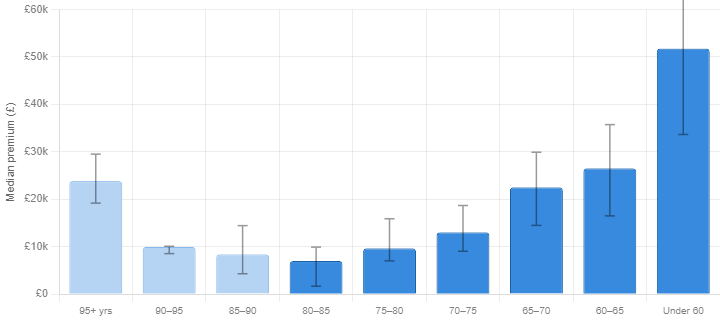
Premiums remain broadly modest above 80 years, then jump sharply once marriage value becomes payable — the dominant threshold effect in the dataset.
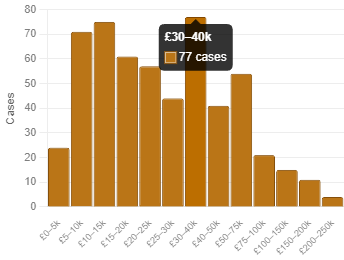
The distribution shifts materially right once cases fall below 80 years, illustrating both a higher median and a wider spread of outcomes.
Above and below 80 years: what the tribunal data shows
The difference in tribunal-determined premiums above and below 80 years is one of the starkest findings in the LeaseIntel dataset. Across 595 decisions with lease length data, leases above 80 years show a median premium of £8,076. Leases below 80 years show a median of £28,300 — 3.5 times higher.
This is not a coincidence. It is a direct consequence of how the statutory valuation formula works. Below 80 years, the leaseholder must pay 50% of the marriage value — the uplift in property value that results from the extension — in addition to the reversionary and ground rent components. Above 80 years, no marriage value is payable. The 80-year threshold is therefore a legislative cliff edge built into the premium calculation itself.
| Lease position | Decisions analysed | Median premium | Mean premium |
|---|---|---|---|
| Above 80 years | 39 | £8,076 | £9,798 |
| Below 80 years | 556 | £28,300 | £87,132 |
The marriage value effect in the data
Looking at the dataset from the marriage value angle — rather than by years remaining — reinforces the picture. Cases where marriage value was identified as applying show a median premium of £30,534. Cases where it was not applicable show a median of £9,230. The ratio between the two is 3.3x.
This is significant because it confirms that the 80-year threshold is not the only factor at work. Even below 80 years, cases with low property values or very modest ground rents may have a marriage value component that is relatively small. Conversely, the closer a lease is to zero years, the more dominant the marriage value component becomes — in the most extreme cases, it accounts for the majority of the total premium.
| Marriage value | Decisions analysed | Median premium | Mean premium |
|---|---|---|---|
| Applies | 316 | £30,534 | £96,411 |
| Does not apply | 69 | £9,230 | £12,947 |
What happens at 79 years — the most expensive year
From a timing perspective, the year in which a lease crosses from 80 to 79 years is the single most consequential in the extension timeline. Before this point, premiums above 80 years are modest and the extension can often wait. After this point, marriage value becomes payable on every year of delay.
The tribunal data shows leases in the 75–79 year band carrying a median premium of £9,620, compared with £6,950 for leases in the 80–84 year band — an increase of approximately 38% from just crossing the threshold. As the lease shortens further through the 70s, the effect compounds: each year below 80 adds to both the marriage value (as property prices generally rise) and the reversion component (as the lease approaches shorter and shorter terms).
For a property worth £400,000, the marriage value component at 79 years remaining is typically £15,000–£30,000. At 70 years remaining, that figure may have grown to £25,000–£45,000 or more, purely as a consequence of waiting.
Received a lease extension quote?
Compare it against comparable First-tier Tribunal decisions.
Check My QuoteFrequently asked questions
Methodology
LeaseIntel analyses published First-tier Tribunal (Property Chamber) decisions on lease extension premiums. Each decision is parsed into a structured record covering unexpired term at the valuation date, property value, ground rent profile, deferment and capitalisation rates, marriage value treatment and the final premium determined.
- Analyses only include decisions containing the specific lease-term and valuation data required for that study.
- Cases are grouped by unexpired term at the valuation date (not the date of the decision).
- Sample sizes vary between analyses because not every decision records every variable.
- Small sample groups are flagged with a confidence indicator and interpreted cautiously.
- Where decisions span multiple flats or hearings, each lease is treated as a separate observation.
Read the full LeaseIntel methodology for dataset construction, variable definitions and validation checks.
Limitations & Caveats
- Tribunal decisions represent disputed cases rather than the entire market.
- Not all decisions contain every data field.
- Sample sizes vary by analysis.
- Small sample groups should be interpreted cautiously.
Benchmark your quote
These figures are based on 595 tribunal decisions with lease length data. Your own premium depends on your specific lease length, property value, ground rent terms and whether marriage value applies. LeaseIntel compares your circumstances with similar tribunal decisions to provide a personalised benchmark — including whether acting now vs later materially changes your expected premium.
Is My Lease Extension Quote Too High?Independent · Not a valuation or legal advice · Tribunal outcomes, not formula estimates