- Median premiums are 79% higher just below the 80-year threshold than just above it — the single most costly crossing in the dataset.
- Below 70 years remaining, each decade of delay roughly doubles the typical premium.
- Waiting is most expensive precisely when a lease is closest to the 80-year threshold — often the point at which leaseholders defer action.
- The cost of waiting is heavily driven by property value, because marriage value scales with the underlying flat value.
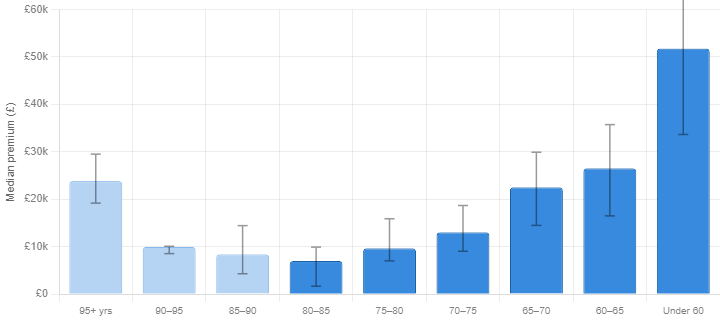
Each lease-length band on this chart is a snapshot of what tribunals have determined for comparable cases. Reading right-to-left shows the effective cost of continued delay.
How the cost rises as the lease shortens
The tribunal data tells a clear story: premiums rise at an accelerating rate as lease length falls. The increase is not linear — it compounds. Moving from 85 years to 75 years typically costs far more in additional premium than moving from 95 years to 85 years, and moving from 75 years to 65 years costs more again.
The table below shows median premiums across lease length bands from the LeaseIntel dataset. The jump from the 80–89 year band to the 70–79 year band (£7,046 to £12,622) represents a 79% increase in the typical premium — and this is before the most expensive territory, below 60 years.
| Years remaining | Decisions analysed | Median premium | vs next band up |
|---|---|---|---|
| 80–89 years | 30 | £7,046 | — |
| 70–79 years | 103 | £12,622 | +79% |
| 60–69 years | 213 | £23,463 | +86% |
| 50–59 years | 136 | £41,384 | +76% |
| 40–49 years | 41 | £47,300 | +14% |
| Under 40 years | 63 | £236,988 | +401% |
The 80-year threshold: where the real cost of waiting hits
The most consequential moment in a lease extension timeline is crossing the 80-year threshold. Under current legislation, marriage value — the uplift in property value that results from extending the lease — is only payable when the lease falls below 80 years. This creates a step-change in premiums that is visible in the tribunal data.
Leases in the 80–89 year band show a median premium of £7,046. Leases in the 70–79 year band show a median of £12,622 — a difference of £5,576. For a property worth £400,000, the real-world cost of crossing this threshold is typically even larger, as marriage value on higher-value properties represents a larger absolute sum.
The implication is direct: a leaseholder with 82 years remaining who delays extending by three years — crossing below 80 years — faces a premium increase that, in the tribunal data, represents approximately 79% more than if they had acted above the threshold. In cash terms on a typical London flat, this is often £8,000–£20,000 or more.
The rising trend in premiums over time
Beyond the lease-length effect, the tribunal data also shows a rising trend in median premiums over time. The median determination has risen from £17,133 in 2015 to £36,750 by 2025 — more than doubling over ten years. This reflects both rising London property values and the gradual composition of the dataset shifting toward shorter-lease, higher-value cases as leaseholders with longer leases have less urgency to go to tribunal.
The practical implication: a leaseholder who defers extending is not only allowing their lease to shorten — they are also extending into a market where the underlying freehold values, and therefore the premiums, are rising. The combined effect of lease shortening and market appreciation makes delay more costly than either factor alone.
| Year | Decisions | Median premium determined |
|---|---|---|
| 2015 | 70 | £17,133 |
| 2016 | 48 | £24,188 |
| 2017 | 79 | £24,591 |
| 2018 | 98 | £24,499 |
| 2019 | 96 | £28,320 |
| 2020 | 34 | £26,193 |
| 2021 | 58 | £28,820 |
| 2022 | 51 | £33,034 |
| 2023 | 27 | £34,950 |
| 2025 | 21 | £36,750 |
Received a lease extension quote?
Compare it against comparable First-tier Tribunal decisions.
Check My QuoteFrequently asked questions
Methodology
LeaseIntel analyses published First-tier Tribunal (Property Chamber) decisions on lease extension premiums. Each decision is parsed into a structured record covering unexpired term at the valuation date, property value, ground rent profile, deferment and capitalisation rates, marriage value treatment and the final premium determined.
- Analyses only include decisions containing the specific lease-term and valuation data required for that study.
- Cases are grouped by unexpired term at the valuation date (not the date of the decision).
- Sample sizes vary between analyses because not every decision records every variable.
- Small sample groups are flagged with a confidence indicator and interpreted cautiously.
- Where decisions span multiple flats or hearings, each lease is treated as a separate observation.
Read the full LeaseIntel methodology for dataset construction, variable definitions and validation checks.
Limitations & Caveats
- Tribunal decisions represent disputed cases rather than the entire market.
- Not all decisions contain every data field.
- Sample sizes vary by analysis.
- Small sample groups should be interpreted cautiously.
Benchmark your quote
These figures are based on 595 tribunal decisions showing how premiums change with lease length. Your own premium depends on your specific lease length, property value, ground rent terms and the valuation date. LeaseIntel compares your circumstances with similar tribunal decisions to provide a personalised benchmark — including the estimated cost of waiting.
Is My Lease Extension Quote Too High?Independent · Not a valuation or legal advice · Tribunal outcomes, not formula estimates